

Pokemon Investing 101 · Episode 5
How to Read a Pokemon Card: Every Part Explained
How to read a Pokemon card from top to bottom: name, HP, type and attacks, then the set code, number and rarity symbol that tell you which card you have.
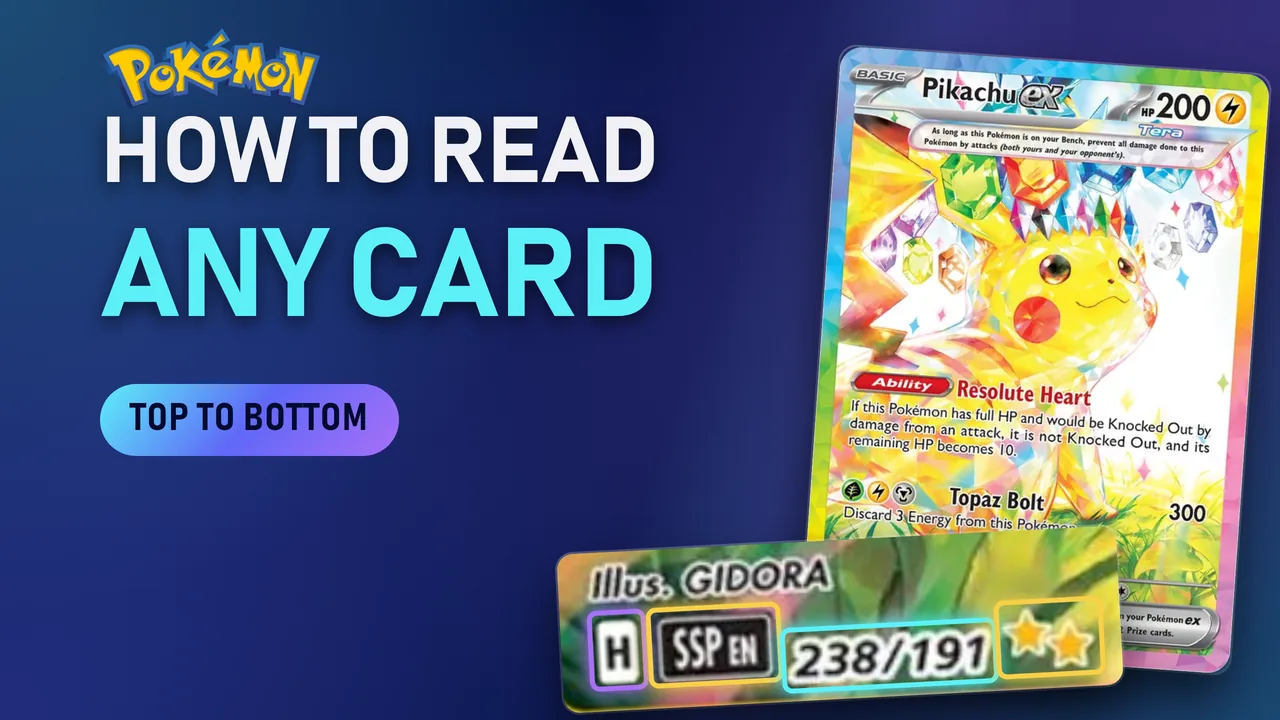
To read a Pokemon card, go top to bottom. The top shows the name, HP, type and stage. The middle holds the ability, attacks, weakness, resistance and retreat cost. The bottom row carries the illustrator, regulation mark, set code, card number and rarity symbol. That bottom row tells you exactly which card you have, and that decides what it’s worth. This guide reads one card, Pikachu ex 238/191 from Surging Sparks, from top to bottom.
This is episode 5 of Pokemon Investing 101, a short series for people just getting into Pokemon cards. Prices below are from when the video was recorded, each with its source, and the latest prices sit beside them. Nothing here is financial advice.
Key takeaways
- Top: name, HP, type and stage. An “ex” in the name comes with its own rule.
- Middle: ability, attacks, weakness, resistance and retreat. Players read this part, and it rarely moves the price much.
- Bottom row: illustrator, regulation mark, set code, number and rarity. This is where collectors look.
- Write down the set code and the number before you look up a price. The same Pokemon in the same set can sell for very different amounts.
The top: name, HP, type and stage
Start at the top. There’s the name, and next to it the HP, which is how much damage the Pokemon can take. The symbol in the top right corner is its type. The word in the top left is the stage: Basic means it can be played on its own, while Stage 1 and Stage 2 Pokemon evolve from another card.
| Part | Where | On Pikachu ex 238/191 |
|---|---|---|
| Name | Top | Pikachu ex |
| HP | Next to the name | 200 |
| Type | Top right corner | Lightning |
| Stage | Top left | Basic |
| ex rule | Box at the bottom | When it’s knocked out, your opponent takes 2 prize cards instead of 1 |
Source: the card itself, Pikachu ex 238/191 (Surging Sparks), as printed.
The “ex” in the name is what brings that rule. It’s printed in a box at the bottom of the card, so you don’t have to remember it.
The middle: abilities and attacks
The middle is the game part. An ability is a power the Pokemon has without attacking. Each attack lists its energy cost on the left and its damage on the right. Under the attacks you’ll find weakness, resistance and retreat cost.
| Part | What it means | On Pikachu ex 238/191 |
|---|---|---|
| Ability | A power used without attacking | Resolute Heart: if a single attack would knock it out from full HP, it’s left with 10 HP |
| Attack | Energy cost on the left, damage on the right | Topaz Bolt: 3 energy, 300 damage |
| Weakness, resistance, retreat cost | Listed under the attacks | Matter for deck play |
Source: the card itself, Pikachu ex 238/191 (Surging Sparks), as printed.
Players read this part to judge how strong a card is in a deck. For collectors, it rarely changes the price by much.
The bottom row: where collectors look
Read the bottom row from left to right. This is the part that identifies the exact card.
| Part | On Pikachu ex 238/191 | What it tells you |
|---|---|---|
| Illustrator | GIDORA | Who drew the card |
| Regulation mark | H | Which cards are legal in Standard tournaments |
| Set code and language | SSP, EN | Surging Sparks, English |
| Card number | 238/191 | Above the set total, so a secret rare |
| Rarity symbol | Two gold stars | Special illustration rare |
Source: the card itself, as printed. Regulation marks: PokeGuardian, Jan 9 2026.
The regulation mark is a single letter. When the video was recorded, the letters legal in Standard were H, I and J, after the April 10 2026 rotation (PokeGuardian, Jan 9 2026). The legal letters change with each yearly rotation.
The set code and the number are the two things to write down before you look up a price. Episode 4 covers every rarity symbol in detail.
Why it matters for price
Two cards can share a name and still be very different cards. The set code and number tell you exactly which one you have, and that’s what you search to find the price, as shown in episode 2.
| Pikachu ex (Surging Sparks) | Rarity | TCGplayer market (at recording) |
|---|---|---|
| 057/191 | Double rare | $4.73 |
| 238/191 | Special illustration rare | $256.63 |
Source: TCGplayer market prices, at the time of recording.
That’s about 54x for the same Pokemon in the same set. A number above the set total means a secret rare. And the copyright line along the very bottom, with the year, is one of the first things to check on a possible fake. Episode 3 covers the full fake check.
The mistake: pricing a card by its name alone. The rule: write down the set code and the number, then search for that exact card.
FAQ
What does the number at the bottom of a Pokemon card mean? It’s the card’s number in its set, shown over the set total, like 238/191. A number above the set total means a secret rare.
What is the regulation mark on a Pokemon card? A single letter on the bottom row, like H. It decides which cards are legal in Standard tournaments. When the video was recorded, that was H, I and J, and the legal letters change with each yearly rotation (PokeGuardian, Jan 9 2026).
What does ex mean on a Pokemon card? It means the card follows the ex rule, printed in a box at the bottom: when it’s knocked out, your opponent takes two prize cards instead of one.
Which part of a Pokemon card decides its value? The bottom row. The set code, card number and rarity symbol tell you exactly which version you have. HP and attacks matter to players but rarely move the price much.
Sources
- The card itself: Pikachu ex 238/191, Surging Sparks, as printed (HP, type, stage, ex rule, Resolute Heart, Topaz Bolt, illustrator GIDORA, regulation mark H, set code SSP EN). Checked for the video.
- TCGplayer market prices: Pikachu ex 238/191 $256.63 and Pikachu ex 057/191 $4.73. Captured for the video.
- PokeGuardian, Standard regulation marks from Apr 10 2026 (H, I and J), published Jan 9 2026. Checked for the video.
Not financial advice. Prices move fast, so the latest prices sit beside the ones from when the video was recorded.
Previous: Pokemon Card Rarities Explained
Next in Pokemon Investing 101: Pokemon Reprints Explained: When Should You Buy?