

Pokemon Investing 101 · Episode 3
How to Tell if Pokemon Cards Are Fake: 6 Quick Checks
How to tell if a Pokemon card is fake: 6 checks for the text, back, edge, texture and size, plus how to spot resealed packs, fake boxes and fake slabs.
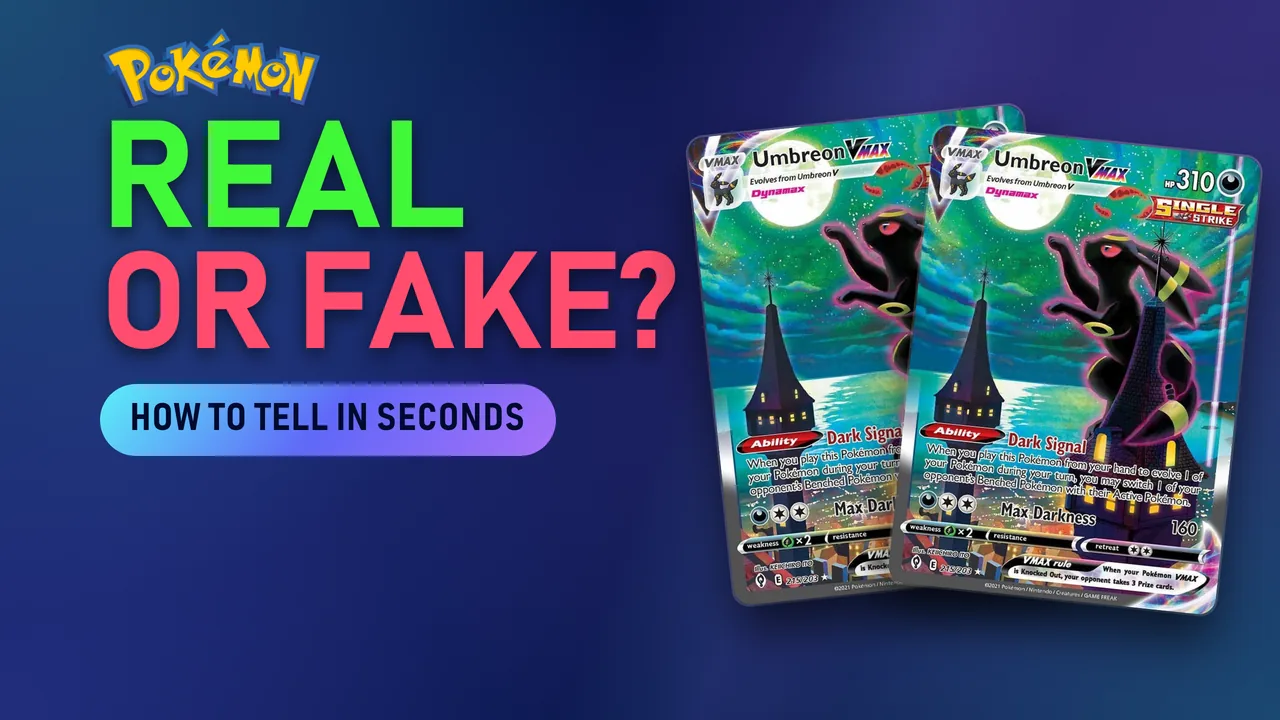
To tell if a Pokemon card is fake, run six checks: read the text and look the card up by its number, check the back, check the edge, feel the texture, measure it, and verify sealed wrap and grading cert numbers. Most take about ten seconds. No single check is proof, because some newer fakes pass the old tricks. If a card fails two checks, treat it as fake.
This is episode 3 of Pokemon Investing 101, a short series for people just getting into Pokemon cards. Prices below are from when the video was recorded, each with its source, and the latest prices sit beside them. Nothing here is financial advice.
Key takeaways
- Read the card, then look it up by its number. The art, HP, attacks and illustrator should all match the real card.
- Compare the back and the edge with a card you know is real. Side by side, the differences are easy to see.
- Don’t trust one test. Some newer fakes add a dark core layer, and many match the weight of a real card.
- If a card fails two checks, treat it as fake. A price far below recent sales is a warning on its own.
Check 1: read the card and look it up
Start with the text. Fakes often get small things wrong.
| Look at | Red flag |
|---|---|
| Spelling | Typos, or a missing accent on the e in Pokemon |
| Font | Text that looks too bold or too thin |
| HP and attack damage | Numbers that seem too high |
| Bottom of the card | No copyright line with the year |
Sources: Wargamer, “How to identify fake Pokemon cards” (Jan 31 2025), and PreGrade Cards counterfeit guide (2026), both checked for the video.
Then look the card up by its number, for example 215/203, on TCGplayer or the official Pokemon card database. The art, the HP, the attacks and the illustrator should all match. Episode 5 shows where each of these sits on a card.
Check 2: the back
Flip the card over. On a real card, the light blue swirl around the Poke Ball has darker blue speckles in it.
| Back of the card | Real card | Common fake |
|---|---|---|
| Light blue swirl | Darker blue speckles | Flat, washed out or purple |
| Poke Ball | Centered | A little off center |
Sources: Wargamer (Jan 31 2025) and PreGrade Cards (2026), checked for the video.
Put the card next to one you know is real. Side by side, the difference is easy to see.
Check 3: the edge and the light test
Real cards have a thin dark layer in the middle, so the edge shows a fine dark line. A solid white edge is a red flag. You can also shine a phone light through the card in a dark room. A real card blocks most of it.
| Test | Real card | Proof on its own? |
|---|---|---|
| Edge | Fine dark line from the core layer | No, some newer fakes add a dark layer |
| Phone light in a dark room | Blocks most of the light | No, for the same reason |
| Rip test | Destroys the card | Skip it |
Sources: PreGrade Cards counterfeit guide (2026) and Wargamer (Jan 31 2025), checked for the video.
Skip the rip test you see online. It ruins a real card too.
Check 4: texture and holo shine
Modern full arts, illustration rares and special illustration rares have a fine etched texture you can feel with a fingernail. Fakes usually feel smooth and glossy. Episode 4 explains what each of those rarities is.
Then tilt holo cards under a lamp. Real foil moves with depth as the light changes. A fake often has a flat rainbow over the whole card.
Checks 5 and 6: size, sealed product and graded slabs
Check 5 is size. English cards are 63 x 88 mm (2.5 x 3.5 in), so measure against a real one. Weight is a weak test, because many fakes match it.
Check 6 covers sealed product and graded cards.
| Item | Real | Red flag |
|---|---|---|
| English card size | 63 x 88 mm (2.5 x 3.5 in) | Doesn’t match a real card |
| Weight | Weak test | Many fakes match it |
| Booster box wrap | Small Pokemon Company logos in the film, clean factory seams | No logos, messy seams |
| Booster pack | Sharp, even crimps | Uneven or melted crimps, glue |
| Graded card | Cert number matches the card and grade | Card or grade doesn’t match |
Sources: Wargamer (Jan 31 2025), PreGrade Cards (2026), Geeky Domain (Sep 8 2026, citing SNKRDUNK) and Pokefolio, checked for the video.
For a graded card, type the cert number into the grading company’s website and make sure the card and the grade match. Episode 9 covers PSA grading in detail.
Price and the two-check rule
Price is a check too. Know what the real item sells for before you look at a listing.
| Evolving Skies booster box | Price |
|---|---|
| Sold price, at recording | $2,295.14 |
Source: PriceCharting sold price, at the time of recording.
With real boxes selling at that level, one listed for $300 isn’t a deal. It’s a warning. Episode 2 shows how to look up sold prices.
For an expensive card, ask the seller for clear photos of the actual card, front and back, not a stock image. One odd detail can be a factory misprint. Two odd details are a pattern.
The mistake: trusting a single test, or a price that looks too good. The rule: if a card fails two checks, treat it as fake.
And if a valuable card still leaves you unsure, take it to a local card shop or send it to a grading company before you pay.
FAQ
What is the quickest way to tell if a Pokemon card is fake? Read the text, compare the back with a real card and look at the edge. Most of these checks take about ten seconds. Then look the card up by its number and make sure the art and attacks match.
Does the light test prove a Pokemon card is real? No. A real card blocks most of a phone light, but some newer fakes add a dark layer to pass this test. Use it with the other checks, never on its own.
How do I spot a resealed Pokemon pack or a fake booster box? Packs should have sharp, even crimps and no glue. Modern booster boxes have small Pokemon Company logos in the wrap itself and clean factory seams.
How do I check if a graded Pokemon card is real? Type the cert number into the grading company’s website and make sure the card and the grade match the slab you are looking at.
Sources
- Wargamer, “How to identify fake Pokemon cards” (Jan 31 2025): card size, the back check, the copyright line, weight, the rip test. Checked for the video.
- PreGrade Cards, Pokemon counterfeit guide (2026): core layer and light test, etched texture, weight, the two-test rule. Checked for the video.
- Geeky Domain, fake sealed product red flags (Sep 8 2026, citing SNKRDUNK), and Pokefolio: booster box wrap and resealed packs. Checked for the video.
- PriceCharting: Evolving Skies booster box sold price, $2,295.14. Captured for the video.
Not financial advice. Prices move fast, so the latest prices sit beside the ones from when the video was recorded.
Previous: How to Check What a Pokemon Card Is Worth
Next in Pokemon Investing 101: Pokemon Card Rarities Explained